Run all of Isomer inside your own Azure tenant.
Isomer™ installs from the Azure Marketplace as an Azure Managed Application: single-tenant in your tenant, with your keys and your models, and no public internet exposure if you want none. Claim data never leaves your perimeter.
Opening with a limited number of carriers, TPAs and MGAs.
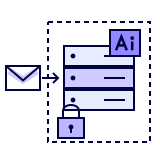
Sovereign means the whole system, models included.
The entire system runs on your infrastructure, under your governance. Data never crosses your perimeter, not because a contract promises it won’t, but because the architecture gives it nowhere else to go.
The models run where your data lives
Inference runs inside your Azure tenant, through your own Azure AI services and model keys, or on open-weight models that run entirely within it. No claims content goes to an Isomer-hosted endpoint.

Nothing crosses your perimeter
Communications, attachments and what is extracted from them stay in your environment for their whole life. Retention and deletion follow your policy, on your schedule.

Your stack, your controls
Your identity provider, network boundary, key management and logging. Isomer becomes software your team runs, under the controls you already operate.
A zero-retention agreement still sends your data out.
Carriers have stood up AI review boards, and the most common question they ask is the simplest: where does the data actually go?
A zero data retention agreement answers what happens after the data arrives somewhere else. It doesn’t answer whether the data left. Sovereign deployment is the only answer where nothing was sent in the first place.
Zero data retention agreement
Nothing is stored after the call
- Every claim document and policyholder detail still travels to a model provider’s API.
- Retention is a contractual promise about infrastructure you don’t operate.
- Your review board audits someone else’s controls.
Isomer sovereign deployment
Nothing is sent at all
- The models run inside your environment, so there’s no outbound call to govern.
- Retention, deletion and access follow the controls your team already operates.
- Your review board audits infrastructure it owns and can inspect directly.
The most sensitive data in a claim arrives before the claim exists.
Isomer reads inbound communications at the point of receipt, before anything reaches your claim system. That’s why sovereignty matters more here than anywhere downstream.
- Before the system of record. Your claim system governs records. Isomer works on everything before the record exists: the email, the attachment, the fax, the transcript.
- Unstructured and unredacted. Demand letters, medical records and attorney correspondence arrive exactly as the sender attached them. It’s the least governed moment in a claim, and the most sensitive.
- Every detector runs in-house. Isomer Signals checks each communication against 90+ detectors. In a sovereign install, every one of those checks runs on infrastructure you control.
- The accountability stays with you. You answer for how AI is used on your claims even when a vendor runs it, so where the data goes matters most where it is rawest.
Why this is possible now.
Open-weight models have become good enough for most operational claims work, including small models that run on modest infrastructure. We know because we’ve moved our own workloads onto them.
That changes the economics as well as the architecture. Sovereign removes the barriers that keep AI away from the highest-value claims work, and optimized open models make reviews faster.
“Large companies don’t want a vendor black box. They want AI that is part of their own foundation.”
Sean Chou, co-founder and CEO
The controls carry over.
A sovereign install has the same security and AI governance our regulated customers already review.
SOC 2 Type II
Audited controls across security, availability and confidentiality, monitored continuously.
No training on your data
Your claims data serves your operation only. It never trains a model.
Cited to the page
Every signal carries the sentence, document and page that triggered it.
Reconstructable
The record shows what came in, which version handled it, where a person stepped in and how it ended.
Uncertainty goes to a person
When confidence is low, the item routes to review instead of passing silently.
NAIC and NIST
Aligned with the NAIC Model Bulletin on AI Systems and the NIST AI Risk Management Framework.
Talk to the founders about a sovereign install.
Sovereign engagements start with our founders, Sean Chou and Sean Casey. Tell us where you are and what your environment looks like.